By George Desnoyers
October 24, 2025
A principle that admits no exception anywhere in the universe—yet is periodically denied—deserves to be stated formally as the cosmic law it is, and to have a name. In this essay I will state Desnoyers’ Law, a universal law of metaphysics. I will explain the law, show how it can easily be deduced, and defend it against anticipated objections.
Statement of Desnoyers’ Law and Definition of Nature
Before any defense can be made, the Law itself must be stated plainly and the key term on which it depends must be understood. Desnoyers’ Law may be stated as follows: Every thing has one, and only one, nature; there are no exceptions. To see why this is not a conjecture but a truth that follows necessarily from what nature means, we must first examine that word itself.
Nature, here, is to be understood in the sense in which the word is used in metaphysics:
“The nature of a thing is the sum of all the essential properties that make it what it is, keep it what it is despite any changes in non-essential properties, and distinguish it from all other kinds of things.”1
Desnoyers’ Law holds true in any system of metaphysics in which the above definition of nature is accepted as valid.
Desnoyers’ Law applies in the realm of logic and rational human thought. Within that realm, the Law holds without exception: everything that exists possesses one, and only one, nature.
But when claims describe realities said to transcend human understanding—what theology calls mysteries—these stand outside the boundaries of metaphysical analysis. Such cases do not contradict the Law; rather, they mark the limits of logic and the human categories within which the Law operates.
True by Definition
Desnoyers’ Law is easily deduced from the above definition of nature—the definition used in metaphysics—and is therefore true by definition.
If you, the reader, were like me back in the second grade, you might have tried to convince your teacher that while her answer to an addition problem was correct, your different answer was also correct. And if your second-grade teacher was like mine, she explained that every addition problem, without exception, has only one correct answer—hers.
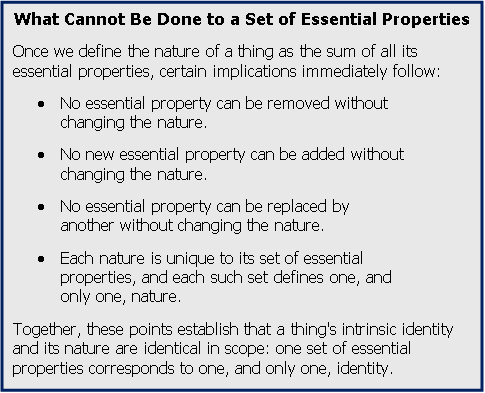
Look again at our definition: the nature of a thing is the sum of all its essential properties. Just as every addition problem has a single correct answer, every thing that exists has one correct sum of all its essential properties—that is, one nature and no more.
Replies to Anticipated Objections
Having stated Desnoyers’ Law, explained it, and shown how it can easily be deduced from the definition of nature in metaphysics, it remains for me now only to defend the Law against anticipated objections.
Objection No. 1: The Supposed Dual Nature of Light
Light acts as waves in some experiments and as particles in other experiments. Doesn’t that prove that light has two natures, and that Desnoyers’ Law is wrong?
Reply: This has been the objection raised more often than any others in the two decades plus in which I’ve been discussing this subject. The only other objection that has been raised nearly as often has been one involving the Hypostatic Union—or the two different natures of Jesus Christ—which I will discuss below.
Nature is not about how something acts in a particular context or experiment. The nature of a thing is what defines what the thing is—its essence.
It is true that light, which is the visible portion of the electromagnetic spectrum, behaves as waves in some experiments and like particles in others. That doesn’t mean that light has two different natures. Rather, it is within the single nature of light to behave as it does in all experiments. How something behaves depends in part on how it is being examined, tested, or measured.
For an analogy, consider a buzzer. A buzzer could be noisy in one experiment and completely silent when the same experiment is conducted in a vacuum. Those two different behaviors do not mean the buzzer has two natures. Just as the buzzer’s essential nature remains the same despite different behaviors, so too the nature of light remains one, even as it acts as waves in some experiments and as particles in others.
The nature of light is what defines its essence—what light is. How light, or anything else, acts in a particular context is not a nature. Desnoyers’ Law remains valid.
Objection No. 2: Composite Beings
A car is made of many parts, and a human body of many organs. Couldn’t such things have multiple natures at once?
Reply: When something has multiple components, that does not mean it has multiple natures, or essences.
Certainly, every car part has its own nature—the nature of whatever kind of car part it is. An assembled auto transmission, for example, has the nature of an auto transmission. However, the whole car has its own nature, which is entirely separate from the natures the parts have individually.
Remember, a pile of car parts is not a car. It is the organization into a coherent unity that gives rise to the one nature of a car.
This is not true only of cars. Anything that is made of parts has one, and only one, nature, which is separate from the natures the thing’s components have individually. Desnoyers’ Law holds.
Objection No. 3: Dichotomous Human Beings
All human beings have a material nature and a spiritual nature. That proves Desnoyers’ Law is mistaken.
Reply: This objection is referring to the belief that humans are dichotomous beings, i.e., made of both material bodies and spirits.2
Granted, we have both material and spiritual aspects. However, in metaphysics, nature does not mean merely an aspect. The nature of a thing is the sum of all essential properties making a thing what it is. It is the defining essence of a being, no matter how many parts, aspects, or faculties it might have. The material and spiritual aspects of a human being are not separate natures; they are only separate manifestations or properties of a single human nature.
While it may be common for people to speak casually of humans as having a material and a spiritual nature, the word nature is, in that case, being used in a different sense from its meaning in metaphysics. In terms of metaphysical reality, each human has one, and only one, nature, fully expressed through both body and spirit. Desnoyers’ Law remains intact.
Objection No. 4: Changes Over Time
An acorn becomes an oak tree, a human baby becomes a human adult, a caterpillar becomes a butterfly, water becomes ice or steam. Aren’t these changes indicative of things having multiple natures, proving Desnoyers’ Law false?
Reply: The first three of those are changes in the state of development. The seed and the tree share the same underlying nature: that of an oak. The caterpillar and butterfly are the same species, a species with the intrinsic capacity for metamorphosis. The caterpillar and butterfly are only at different stages of their species’ life cycle. A human adult is the same person as when the adult was a baby. In all those cases, there is only a change in the state, or stage, of development; there is no change in any of the essential properties making the thing what it is.
The fourth change, water into ice or steam, is only a change in the physical state of water. It was water before the change and water after the change.
Remember, change in appearance, form, stage of development, or physical state does not equal a change in nature. None of these changes is indicative of more than one sum (or set) of essential properties making something what it is. Desnoyers’ Law holds: Every thing has one, and only one, nature—no exceptions.
Objection No. 5: Ambiguity and Imprecision in Classification
My aunt says a tomato is a fruit, and my uncle says a tomato is a vegetable. I’ve seen many similar situations in which people have classified things differently. Isn’t that proof that things can have multiple natures, and that Desnoyers’ Law is wrong?
Reply: The case with the tomato is a case of ambiguity or imprecision in classification. It doesn’t involve anything inherent in the tomato itself. A deficiency in our knowledge has no effect on the reality of what things are. Yes, our categories may be imprecise; however, in reality, a thing retains its one true nature regardless of what we call it or how many different names we give it. As Abraham Lincoln pointed out, we can call a dog’s tail a leg if we want to; however, the fact will remain that the dog has four legs and one tail. Calling a tail a leg doesn’t make it a leg.
In brief, a tomato has only one nature, that of a tomato. This is true regardless of whatever you, me, and your aunt and uncle call it. Desnoyers’ Law survives.
Objection No. 6: From Display of Affection to Murder
Consider the way a lad might gently and affectionately pat his girlfriend. Now, consider how the same act, merely by being intensified, can change from a display of affection to battery, to attempted murder, and, in the worst case, to murder. Certainly, this is proof that Desnoyers’ Law is not true.
Reply: This objection arises from the way everyday language differs from the language of metaphysics. Admittedly, in ordinary speech we do say that the nature of an act sometimes changes when there is a change in intensity, or in degree, or in magnitude, or in quantity. However, when we do that, we are using the word nature in a different sense than its meaning in metaphysics.
If we look at our example closely, we see that the metaphysical nature of the act has not really changed. Throughout the example, we have the same basic act of one person contacting another person with some degree of pressure. So, metaphysically speaking, the act’s nature has not changed along with the increased intensity. What has changed along with intensity is the moral judgment called for. However, the moral judgment the act calls for is not an essential property of the act. It is a non-essential3 property, and it does not affect the act’s metaphysical nature.
Friendly petting, battery, and even murdering via battery are different moral species of the same kind of human action—bodily acts involving force upon another person. They differ in moral gravity, but not in metaphysical kind.
Degree, intensity, magnitude, or quantity can alter an act’s moral or legal classification, but not the act’s metaphysical essence. Desnoyers’ Law stands: there is one, and only one, nature per thing.
Objection No. 7: Relativism of Perspective
Different people may view and name something differently because of their own perspectives. For example, a person may be viewed and named as a mammal by a biologist, as a voter by a political candidate, or as a soul by an evangelist. Those are different things; isn’t this proof that a person has multiple natures and that Desnoyers’ Law is in error?
Reply: Those people’s different perspectives are placed on the same nature, not different natures. Different people may admire a diamond for its cut, or its clarity, or its brilliance, but it remains one stone. A multiplicity of descriptions does not destroy a thing’s unity of being. Desnoyers’ Law survives.
Objection No. 8: The Two Natures of Jesus Christ
Jesus Christ was true God and true man at the same time. That could not be the case unless he had two natures. If one person, Jesus Christ, could have two natures, then Desnoyers’ Law must be wrong.
Reply: I saved this objection for last because it is the objection that interests me most. It asserts that one person, Jesus Christ, had two separate and distinct natures. By doing that, the objection seems at first glance to be a very direct challenge to Desnoyers’ Law. However, as we will see, not everything is as it first appears.
This objection is referring to what is called the Hypostatic Union—the two natures (human and divine) in Jesus Christ. Christianity’s dogma of the Hypostatic Union was established formally at the Council of Chalcedon in 451 AD. In brief, the Chalcedonian Definition of the dogma states:
“We confess one and the same Christ, the Son, the Lord, the Only-Begotten, to be known in two natures—divine and human—’without confusion, without change’ (so the natures are not blended or altered), and ‘without division, without separation’ (so they are not pulled apart into two persons).”4
In order to properly understand this objection, it is crucial to know that the doctrine of the two natures in Christ has been declared a mystery. Christianity defines a mystery as something that cannot be known without divine revelation, and that cannot be fully understood by the human mind even with divine revelation. Calling the two natures in Christ doctrine a mystery is Christianity’s acknowledgement that the doctrine lies outside the realm of logic and unaided human reason. Being outside that realm, the doctrine avoids even rubbing shoulders with Desnoyers’ Law.
There is a realm to which the Hypostatic Union doctrine does belong; it is the realm of Faith. However, in the realm of logic and human reason, Desnoyers’ Law still stands.
Conclusion: The Universality of Desnoyers’ Law
Desnoyers’ Law of metaphysics states: Every thing that exists has one, and only one, nature. It follows directly from the definition of nature in metaphysics.
Every objection considered has failed. Most failed for the same reason: each confused what a thing does, appears to be, or is called with what a thing is. Desnoyers’ Law stands untouched because it operates at the level of essence—what a thing is in virtue of the sum of its essential properties.
To call something a mystery, as theology sometimes does, is not to deny the Law but to acknowledge that our minds have reached the boundary of its operation. Within that boundary—within the world of reason, analysis, and definition—there can be no exception. This is not conjecture but logical necessity: if anything could possess two natures, it would not be one thing, but two. Desnoyers’ Law therefore expresses a truth coextensive with rational thought—a universal law of metaphysics—beyond which no exception can even be imagined without contradicting reason itself.
Footnotes:
- Although the precise words used to express the metaphysical concept of nature have varied over time, the core meaning has remained remarkably consistent. The idea can be traced back to ancient Greek philosophy, particularly to Aristotle’s conception of nature (physis).
Aristotle’s account of a thing’s nature included elements that most modern philosophers no longer consider essential to a definition. For example, he divided a thing’s essence into form (its defining structure or organization) and matter (what it is made of), and he believed that substances could remain themselves even as their forms changed. Aristotle also considered a thing’s telos—its purpose or end—to be intrinsic to its nature. While this teleological view remains influential in some fields (such as ethics and biology), most modern philosophers distinguish between a thing’s nature (what it is) and its purposes (what it is for).
Although Aristotle’s idea of nature included metaphysical elements that most modern philosophers no longer accept, the fundamental notion of defining a thing by what it is—its essence—remains rooted in his thought. - There is another theory held by some that humans are trichotomous beings, each having a material body and two non-material components: spirit and soul.
- Non-essential properties are sometimes referred to as accidental properties.
- See https://credomag.com/2021/02/the-chalcedonian-definition/ for a complete text of the Council of Chalcedon’s Definition of the Doctrine of the Hypostatic Union. Another website with the complete text of the Chalcedonian Definition is https://www.monergism.com/definition-council-chalcedon-451-ad.1